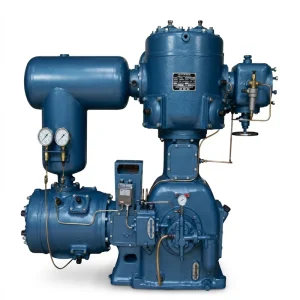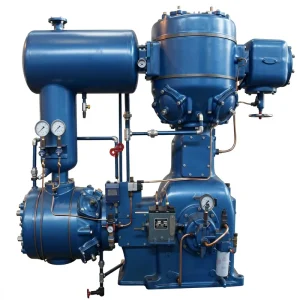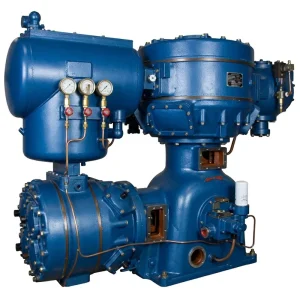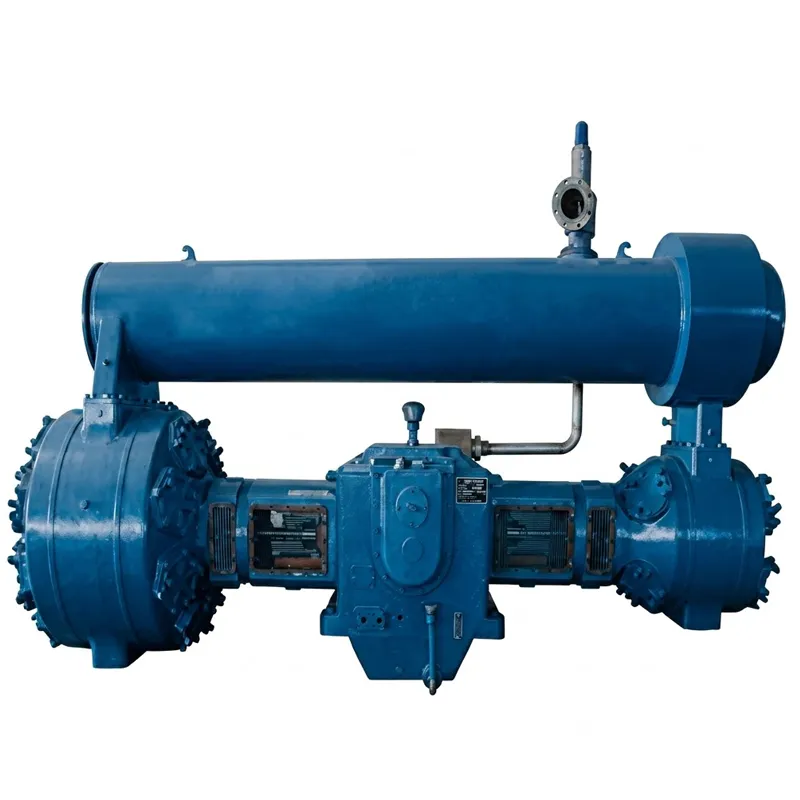
EP-DW-100/8 Reciprocating Air Compressor
The EP-DW-100/8 reciprocating air compressor occupies the upper range of the DW-series — a heavy-duty, two-column two-stage machine configured specifically for oil free compressed air service at high flow rates. Delivering 100 m³/min at a rated discharge pressure of 0.8 MPa, this industrial reciprocating air compressor serves as the primary compressed air source for large petrochemical complexes, pharmaceutical production sites, food and beverage manufacturing plants, and any process environment where air quality regulations prohibit the use of oil-lubricated compression.
At 600 kW drive power, the EP-DW-100/8 reciprocating air compressor operates on high-voltage supply at 6 kV or 10 kV — voltage levels that are standard in large industrial distribution networks and that eliminate the transformer capital cost and step-down losses that lower-voltage machines of equivalent power impose on the site electrical system. The DW-series two-column reciprocating air compressor configuration balances inertia forces from opposing cylinder banks, producing a smoother torque profile and lower structural vibration levels than single-column designs at comparable output.
Oil Free Reciprocating Air Compressor Series
EP-DW-100/8 Reciprocating Air Compressor
A high-capacity, two-column two-stage oil free reciprocating air compressor delivering 100 m³/min at 0.8 MPa. Engineered for large-scale industrial facilities in France, Europe, and global markets where reliable, oil-free compressed air output at sustained high volume is a production-critical requirement. With 600 kW motor drive and 6 kV or 10 kV supply compatibility, this reciprocating air compressor fits directly into large-site electrical infrastructure without the need for additional transformer plant.
Pressure: 0.8 MPa
Power: 600 kW
Oil Free / Two-Stage
6 kV / 10 kV Supply
1. Technical Specifications
Performance data for the EP-DW-100/8 oil free reciprocating air compressor is verified under standard inlet conditions per ISO 1217 Annex C — the harmonised European standard for volumetric compressor acceptance testing applied in France and all EU member states. Buyers comparing this oil free reciprocating air compressor against competing offers from other reciprocating compressor manufacturers can use ISO 1217 as the common performance measurement basis to make valid capacity and efficiency comparisons across the market.
| Parameter | Value | Unit / Remark |
|---|---|---|
| Model | EP-DW-100/8 | Two-column, Two-stage, Oil Free |
| Free Air Delivery (FAD) | 100 | m³/min |
| Rated Discharge Pressure | 0.8 | MPa (≈ 8 bar g) |
| Drive Motor Power | 600 | kW |
| Supply Voltage | 6 kV or 10 kV | 3-Phase, 50 Hz |
| Compression Configuration | Two-column, Two-stage | Oil free cylinder construction |
| Overall Dimensions (L×W×H) | 5456 × 3518 × 2535 | mm |
| Unit Weight | 13.00 | t (metric tonnes) |
| Number of Stages | 2 | With inter-stage cooler |
| Cylinder Lubrication | None — Oil Free | Self-lubricating PTFE-based ring system |
| Cooling Method | Water-cooled (standard) | Inter-stage and after-cooling |
| Crankcase Lubrication | Forced pressure-feed circuit | Oil sealed from compression zone by crosshead |
| Outlet Air Purity Class | Class 0 oil-free (per ISO 8573-1) | No oil content from compressor mechanism |
| Noise Level (at 1 m) | ≤ 85 | dB(A) |
| Ambient Temperature Range | 5 – 40 | °C |
| Safety Relief Valve Setting | 1.1 × Rated Pressure | Per ISO 11011 / PED 2014/68/EU |
2. Five Key Competitive Advantages
What makes the EP-DW-100/8 the preferred oil free reciprocating air compressor for plant engineers specifying large-scale oil free compressed air systems in France, Europe, and across global process industries:
01 — Zero Oil Contamination from the Compression Mechanism
The cylinder and piston assembly of this oil free reciprocating air compressor is completely isolated from the crankcase oil system by the crosshead and piston rod sealing arrangement. No lubricating oil enters the compression chamber at any point in the duty cycle, which means the delivered compressed air carries no hydrocarbon carryover attributable to the compressor mechanism. This is not a filtration-dependent claim — it is a structural characteristic of the oil free reciprocating air compressor design. For food, pharmaceutical, and electronics manufacturing facilities in France and globally, this eliminates the contamination risk pathway that makes oil-lubricated air compressor systems unsuitable for direct product-contact air applications under EU and international food safety and pharmaceutical GMP regulations.
02 — Dynamically Balanced Two-Column Configuration
The DW-series reciprocating air compressor frame places opposing cylinder banks on each side of the crankshaft, creating a symmetric dynamic balance that cancels the primary and secondary inertia forces responsible for structural vibration transmission in single-column designs. At 600 kW and 13.00 t machine mass, this dynamic balancing allows the EP-DW-100/8 oil free reciprocating air compressor to be installed on a lighter reinforced concrete inertia block than an equivalent single-column machine would require, reducing civil foundation costs and allowing shorter project schedules when the site civil works are on the critical path. Reduced vibration also means lower fatigue loading on connected pipework flanges and instrument tapping points — improving long-term integrity of the compressed air distribution system that this oil free reciprocating air compressor feeds.
03 — High-Voltage Drive for Large-Site Electrical Integration
Available in 6 kV and 10 kV motor supply configurations, this reciprocating air compressor integrates directly into the high-voltage distribution architecture that large refineries, chemical complexes, steel mills, and power stations already operate. Eliminating the step-down transformer that a 400 V or 690 V compressor motor would require reduces transformer capital cost, removes a failure-mode component from the drive system, and avoids the electrical losses and voltage regulation issues that transformers introduce. For procurement engineers conducting total installed cost analysis of this oil free reciprocating air compressor versus lower-voltage competing alternatives, the transformer elimination is a material cost advantage that increases with plant electrical infrastructure complexity.
04 — Two-Stage Inter-Cooled Compression for Sustained Energy Efficiency
The two-stage compression cycle of this oil free reciprocating air compressor routes partially compressed air through a water-cooled inter-stage heat exchanger before it enters the second compression stage. By reducing the gas temperature to near-ambient between stages, the inter-cooler lowers the specific volume of the gas entering the second cylinder, reducing the thermodynamic work required to complete the compression to 0.8 MPa. At 600 kW operating power, this inter-stage cooling advantage of the reciprocating air compressor translates into a measurable annual energy cost reduction compared with single-stage machines achieving the same final pressure. This efficiency argument is increasingly significant for French industrial operators subject to mandatory energy audits under the French energy transition law (Loi de transition énergétique) and the European Energy Efficiency Directive, which require large energy consumers to document and improve their specific energy consumption metrics including compressed air generation efficiency.
05 — Full CE & ISO Documentation for EU Compliance
Every EP-DW-100/8 reciprocating air compressor shipped to France and EU markets is accompanied by a comprehensive compliance documentation package: CE Declaration of Conformity for the Machinery Directive 2006/42/EC and Pressure Equipment Directive 2014/68/EU, ISO 9001 quality management system certificate, material test certificates with heat number traceability, hydrostatic test records for all pressure parts, and a performance test report to ISO 1217. Third-party inspection witness hold points during factory production can be arranged through SGS, Bureau Veritas, TÜV Rheinland, or Lloyd's Register, allowing the buyer's quality representative to verify that the oil free reciprocating air compressor is built to specification before release for shipment — a standard practice for major process industry capital equipment procurement in France and across the EU.
3. Reciprocating Air Compressor Working Principle — Oil Free Configuration
The reciprocating air compressor working principle of the EP-DW-100/8 follows the same positive displacement piston-cylinder mechanism that governs all reciprocating air compressor designs, but with a fundamental modification in the cylinder zone that distinguishes it from oil-lubricated counterparts: the compression space contains no lubricating oil at any point during operation. Understanding how this oil free reciprocating air compressor achieves both mechanical function and absence of oil in the compression zone is important for engineers specifying air quality systems in regulated process environments.
The crankshaft, driven by the high-voltage motor through a flexible coupling, converts rotary motion to the reciprocating linear motion of piston assemblies via connecting rods and crossheads. The crosshead is the critical sealing element in the oil free reciprocating air compressor architecture — it runs in a lubricated guide cylinder that is completely separated from the compression cylinder by an intermediate section (the distance piece) that prevents any oil from migrating from the crankcase zone to the gas compression zone. The piston rod, which connects the crosshead to the piston, passes through labyrinth seals and wiper ring assemblies in the distance piece that positively isolate the oil-lubricated crankcase from the oil-free cylinder. This arrangement is the defining structural characteristic of a true oil free reciprocating air compressor, as distinct from a standard lubricated machine fitted with downstream oil-removal filtration.
Within the compression cylinder of this oil free reciprocating air compressor, piston rings and rider rings manufactured from self-lubricating composite materials — typically PTFE-based formulations filled with carbon fibre, graphite, and bronze — provide the sealing and bearing functions that oil-lubricated rings perform in conventional machines. On the intake stroke, the piston retreats, opening the spring-loaded inlet valve and drawing atmospheric air into the first-stage cylinder. On the compression stroke, the inlet valve closes and the trapped air is compressed to the inter-stage pressure, then discharged through the first-stage outlet valve into the water-cooled inter-stage heat exchanger. After cooling, the gas enters the second-stage cylinder of this reciprocating air compressor for final compression to 0.8 MPa discharge pressure. The final discharge passes through the after-cooler and moisture separator before entering the plant distribution network — as clean, oil free compressed air with no hydrocarbon carryover from the compressor mechanism itself.
4. Materials & Construction
The material specification of the EP-DW-100/8 oil free reciprocating air compressor reflects the dual engineering challenge of this product category: the machine must achieve the mechanical robustness of a heavy industrial reciprocating air compressor while simultaneously maintaining a complete oil-free barrier in the compression zone. Each material choice is made with both of those requirements in view, and the combined specification has been validated through extended operational experience in demanding process industry environments across global markets where oil free air compressor performance must be sustained reliably over very long service intervals.
Cylinder Body & Liner
Oil free reciprocating air compressor cylinders are cast from high-grade grey cast iron (HT250 equivalent) and finished with a precisely controlled bore surface roughness optimised for dry-running piston ring compatibility. Unlike lubricated machine cylinders — which rely on an oil film to prevent metal-to-metal contact — the oil free reciprocating air compressor bore must be matched specifically to the self-lubricating ring materials used, because abrasive wear of the ring-bore interface directly determines the service life of the gas seal. Water-cooling passages are cast integrally into the cylinder body to maintain bore temperature within the thermal limits of the PTFE-based ring compound during sustained full-load operation.
Piston Rings & Rider Rings
The piston rings fitted to the oil free reciprocating air compressor compression cylinders are composite PTFE-based rings filled with carbon fibre, graphite, and in certain grades, bronze powder, providing a combination of mechanical strength, low coefficient of friction against the cast iron bore, and thermal conductivity that draws heat away from the sliding interface. Rider rings — which bear the radial load of the piston against the bore — are similarly manufactured from PTFE-based compounds optimised for the specific bore surface finish of this reciprocating air compressor. Ring life under clean inlet conditions is typically in the range of 4,000 to 8,000 operating hours, dependent on inlet air quality, temperature, and duty cycle.
Piston Rod Seals & Distance Piece
The piston rod sealing package of this oil free reciprocating air compressor — comprising scraper rings, wiper rings, and labyrinth seal elements in the distance piece — is the mechanical barrier that maintains the oil-free classification of the cylinder zone throughout the machine's service life. These sealing elements are manufactured from chemically resistant, oil-compatible elastomers and PTFE-based composites that retain their dimensional stability and sealing efficiency across the full operating temperature range of the reciprocating air compressor, without requiring the periodic replacement intervals that are characteristic of less durable sealing material selections in competitive product ranges.
Valves
Inlet and discharge valves for the EP-DW-100/8 oil free reciprocating air compressor are spring-loaded plate valves machined from hardened stainless steel strip (AISI 420 grade), selected for consistent performance in the dry-gas environment of an oil free compression cylinder where the lubricating effect of oil mist — present in conventional compressor valves — is absent. Cartridge-assembly valve design allows complete valve replacement in the shortest practical time during scheduled maintenance, an important feature for a 600 kW reciprocating air compressor where unplanned downtime carries significant production cost implications at the large facilities this machine typically serves.
Crankshaft & Bearings
The crankshaft of this large oil free reciprocating air compressor is a drop-forged alloy steel component inspected by magnetic particle test before machining, engineered for the high cyclic bending and torsional loads transmitted by a 600 kW drive train. Main journal and big-end bearings are trimetal babbitt-lined shells with L10 fatigue lives exceeding 60,000 hours at full rated load. The crankcase lubrication circuit — completely isolated from the compression zone by the crosshead and distance piece arrangement — delivers filtered, temperature-controlled oil to all crankcase friction surfaces via a dedicated pressure-feed circuit with oil pressure and temperature monitoring and automatic machine trip functions.
Frame & Foundation Interface
The main frame of this oil free reciprocating air compressor is a heavy fabricated-steel structure with a precision-machined cast-iron crankcase bolted assembly, designed to maintain shaft alignment accuracy and crankcase rigidity throughout the machine's service life despite the thermal cycling inherent in heavy industrial reciprocating air compressor operation. The frame mounting footprint is designed for installation on a reinforced concrete inertia block with grouted anchor bolts, and foundation loading calculations — including static weight distribution, dynamic force vectors at each anchor bolt, and recommended minimum foundation dimensions — are supplied as standard documentation with the equipment package.
5. Regulatory Compliance & Standards
An oil free reciprocating air compressor operating at 100 m³/min and 600 kW within the EU — and particularly in France — must satisfy a multi-layered regulatory framework spanning pressure equipment safety, machinery safety, air quality requirements, ATEX zoning, and environmental permitting. Procurement engineers specifying this oil free reciprocating air compressor for French industrial sites should verify compliance across each of these dimensions during the supplier qualification and project engineering phase to avoid post-installation regulatory issues.
EU — Pressure Equipment Directive (PED 2014/68/EU)
Pressure-containing components of the oil free reciprocating air compressor — cylinders, inter-stage cooler shells, after-cooler headers, and discharge pipework above applicable pressure-volume thresholds — must comply with PED 2014/68/EU, carry CE marking, and be accompanied by a written Declaration of Conformity. France enforces the PED through the DGPR with periodic statutory inspection for Category III and IV equipment. In France, the technical inspections (contrôles techniques) of installed pressure equipment are conducted by approved Organismes Habilités, and the documentation package provided with this oil free reciprocating air compressor is structured to support the initial registration and ongoing inspection programme.
EU — Machinery Directive 2006/42/EC / Regulation (EU) 2023/1230
As a machine with moving parts driven by an external power source, this oil free reciprocating air compressor is subject to the Machinery Directive, requiring CE marking, a technical file, risk assessment, and a signed Declaration of Conformity before placement on the EU market. From January 2027, the Machinery Regulation (EU) 2023/1230 replaces the directive, introducing additional requirements for software-integrated safety functions. Current export documentation for this reciprocating air compressor covers compliance under the existing directive and is designed to facilitate the transition to the new regulation for long-term project planning purposes.
France — ICPE (Installations Classées pour la Protection de l'Environnement)
In France, compressed air installations above stored-energy thresholds defined in the ICPE rubric 2920 require declaration or authorisation under the Code de l'environnement. At 100 m³/min, 0.8 MPa, combined with the storage receiver volume typically associated with a compressor of this scale, the ICPE rubric threshold is likely to be crossed, triggering administrative permitting obligations before operation begins. French plant engineers should conduct a rubric classification analysis early in the project engineering phase and budget for the associated administrative preparation, submission, and approval timescales, which in France can range from several months for declarations to over a year for full authorisation dossiers.
Air Quality — ISO 8573-1 Class 0
The oil free reciprocating air compressor delivers compressed air classified as ISO 8573-1 Class 0 with respect to total oil content — meaning the oil contribution from the compressor mechanism is zero. This classification is the prerequisite for direct use of compressed air in food contact applications (EU Regulation EC 1935/2004, French DGCCRF guidelines), pharmaceutical manufacturing under EU GMP Annex 1 and 2, and electronics manufacturing in cleanroom environments. The Class 0 oil-free classification applies to the compressor mechanism only; downstream moisture, particle, and microbiological content must be addressed through appropriate point-of-use filtration and drying to achieve the complete compressed air purity class required by the specific application.
EU — ATEX Directives (2014/34/EU & 1999/92/EC)
Pharmaceutical and petrochemical applications of this oil free reciprocating air compressor are frequently located in or adjacent to ATEX classified zones. Directive 2014/34/EU governs equipment placed in explosive atmospheres, while 1999/92/EC governs employer obligations for hazardous area assessment. Where the compressor installation falls within or borders a classified zone, motor selection, instrumentation, and control panel equipment must carry appropriate ATEX Ex certification. Custom ATEX-rated configurations of this oil free reciprocating air compressor are available upon request during the project quotation phase, with motor and panel specifications tailored to the specific zone classification documented in the buyer's area classification drawing.
Global — ISO 1217, ISO 11011 & Quality Management ISO 9001:2015
Acceptance testing of this oil free reciprocating air compressor follows ISO 1217, and energy audit methodology at the installation level aligns with ISO 11011. The manufacturing quality management system has held ISO 9001 certification continuously since 2001. For buyers in North America and the Middle East, ASME Section VIII compliance for pressure vessels and CAGI data-sheet performance reporting can be incorporated on request. For Australian buyers, AS/NZS 3788 for pressure equipment in-service inspection provides the relevant post-installation statutory inspection framework for this type of oil free reciprocating air compressor installation.
6. Application Scenarios
The oil free classification of this reciprocating air compressor opens a range of applications that oil-lubricated machines cannot serve without significant downstream oil-removal infrastructure, while the 100 m³/min capacity ensures the oil free reciprocating air compressor meets the high-volume demands of large industrial facilities rather than being limited to smaller, lower-throughput applications. The following sectors represent primary end-use applications where this oil free reciprocating air compressor has been deployed:
Pharmaceutical Manufacturing
EU GMP Annex 1 (sterile medicinal products) and Annex 2 govern compressed air quality in pharmaceutical manufacturing, prohibiting the use of compressed air with oil contamination in direct product-contact applications. This oil free reciprocating air compressor delivers ISO 8573-1 Class 0 compressed air — the only air purity class acceptable for the most critical pharmaceutical uses — without requiring the coalescing oil-removal filters, carbon adsorbers, and residual oil monitors that oil-lubricated compressed air systems must maintain and validate in pharmaceutical environments. For large pharmaceutical campuses in France operating under the oversight of the ANSM, this oil free reciprocating air compressor's simpler, lower-risk compressed air architecture significantly reduces the engineering burden of compressed air system qualification under EU GMP. The oil free reciprocating air compressor is increasingly specified as the baseline for new large pharmaceutical site compressed air installations across France and the EU, replacing lubricated reciprocating air compressor systems that require ongoing filtration validation.
Food & Beverage Production
Food processing facilities using compressed air for pneumatic filling, sealing, labelling, packaging, and direct product-contact blowing operations must ensure that the delivered air meets food safety requirements under EU Regulation EC 1935/2004 and French DGCCRF guidance on food-contact materials. The oil free reciprocating air compressor provides the underlying mechanical guarantee of zero oil contribution from the compression mechanism, enabling the plant engineer to design a compressed air treatment and distribution system around a confirmed oil-free primary source. At 100 m³/min, this oil free reciprocating air compressor can serve as the primary compressed air source for very large food production sites, including bottling halls, dairy processing plants, and confectionery manufacturing campuses — applications where maintaining consistent oil free air quality across multiple product lines is a fundamental food safety requirement that this reciprocating air compressor design satisfies by construction rather than by filtration.
PET Packaging & ISBM Blow Moulding
High-output PET container production using Injection Stretch Blow Moulding (ISBM) technology requires large volumes of oil free compressed air at 8 bar for the stretch-blow cycle. Hydrocarbon contamination of the pre-blow and blow air circuits in a PET line introduces quality risks — including organoleptic taint in the finished container, interaction with bottled products, and potential non-compliance with food contact material regulations. This oil free reciprocating air compressor eliminates those contamination pathways at the supply source, making it a natural fit for high-volume PET production sites where the reciprocating air compressor is expected to serve multiple ISBM lines simultaneously from a central generation point. The 100 m³/min capacity of this oil free reciprocating air compressor is sufficient to supply several parallel ISBM lines with full pre-blow flow without requiring multiple separate compressor units — a capacity advantage that simplifies the compressed air system layout and reduces the number of individual machines requiring maintenance.
Electronics & Semiconductor Manufacturing
Semiconductor wafer fabrication, flat panel display production, and PCB assembly all use compressed air and nitrogen at various stages of the manufacturing process. In cleanroom environments, oil contamination of the compressed air supply can cause photoresist adhesion failures, oxide layer defects, and soldering joint quality issues that translate to high product reject rates. An oil free reciprocating air compressor supplying the utility air and instrument air systems of an electronics manufacturing campus provides the fundamental contamination control at the generation point, allowing downstream purification and filtration systems to focus on the moisture, particle, and organic trace contamination that cannot be addressed by compressor type selection alone.
Petrochemical & Refinery Instrument Air
Refinery and petrochemical plant instrument air systems — which supply the pneumatic actuators of safety-critical control valves throughout the process plant — must deliver consistently clean, dry compressed air. Oil contamination of instrument air can cause actuator seal degradation, pneumatic signal transmission errors, and valve sticking events that compromise process safety system response. While a conventional reciprocating air compressor with filtration can address oil carry-over, an oil free reciprocating air compressor eliminates the source-level contamination risk, reducing the maintenance burden on the downstream filtration train and providing a more robust compressed air quality assurance basis for the safety instrumented system architecture that governs plant protection in high-hazard refinery environments across France and globally.
Textile & Specialty Materials Manufacturing
Textile plants using pneumatic weaving machines (air jet looms), non-woven fabric production lines, and specialty polymer spinning processes require large quantities of oil free compressed air. Oil contamination of loom air supplies causes yarn breakage, weave defects, and finish quality problems that result in product downgrades and production stops. The EP-DW-100/8 oil free reciprocating air compressor provides the compressed air volume required by large-scale textile operations while guaranteeing the oil-free quality characteristic at the generation source — a combination of capacity and purity that makes it a practical alternative to multiple smaller oil free scroll compressor or oil free screw compressor units operating in parallel at a higher total capital and maintenance cost. Large textile facilities in France and throughout the EU increasingly specify an oil free reciprocating air compressor as the central air generation unit for new plant builds, recognising that product quality assurance and reduced filtration maintenance justify the selection over lubricated alternatives.
7. About Us
Our product portfolio — spanning reciprocating, screw, and diaphragm compressor families across the M, H, D, L, P, Z, LG, JY, and G series — includes oil free reciprocating air compressor models covering a wide range of flow and pressure specifications, from small-site reciprocating air compressor machines to large process plant units of the type represented by the EP-DW-100/8. ISO 9001 certification has been continuously maintained since 2001, providing buyers in France and globally with independently audited evidence of a structured quality management system governing every stage of oil free reciprocating air compressor production.
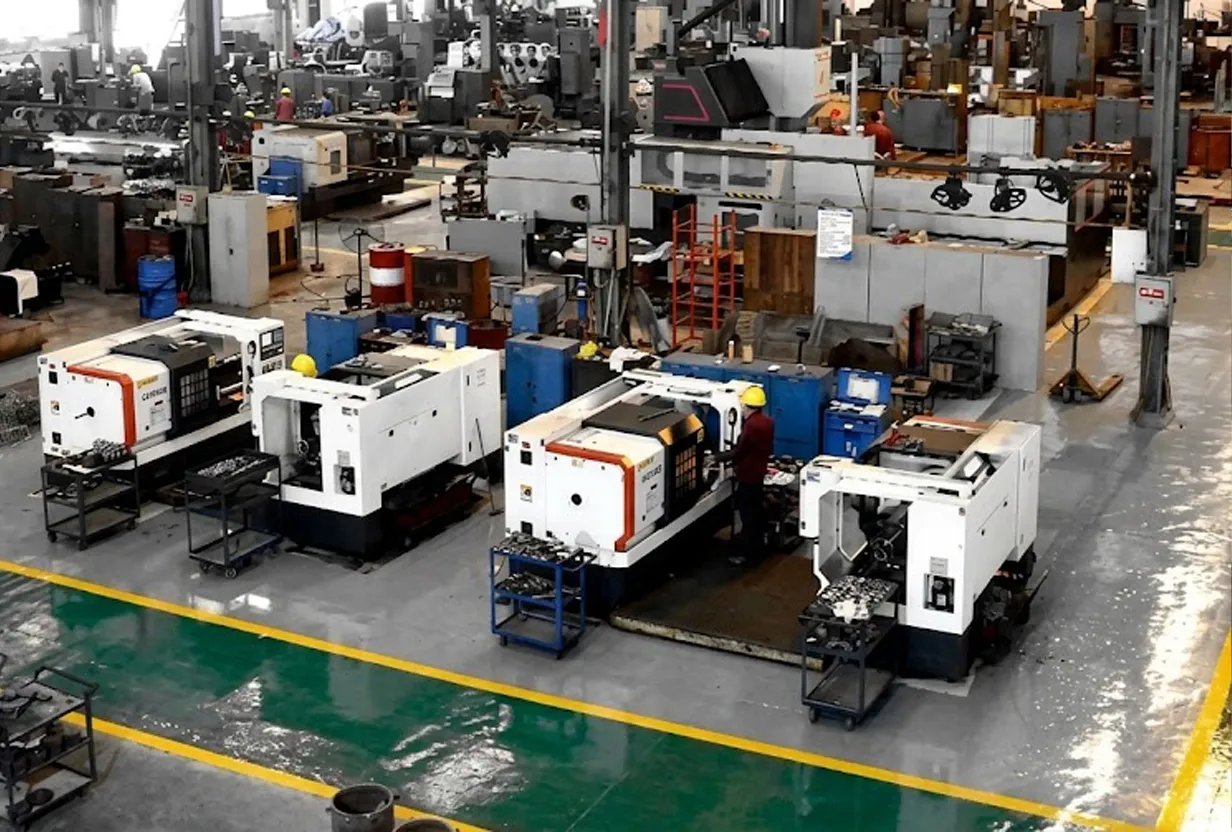
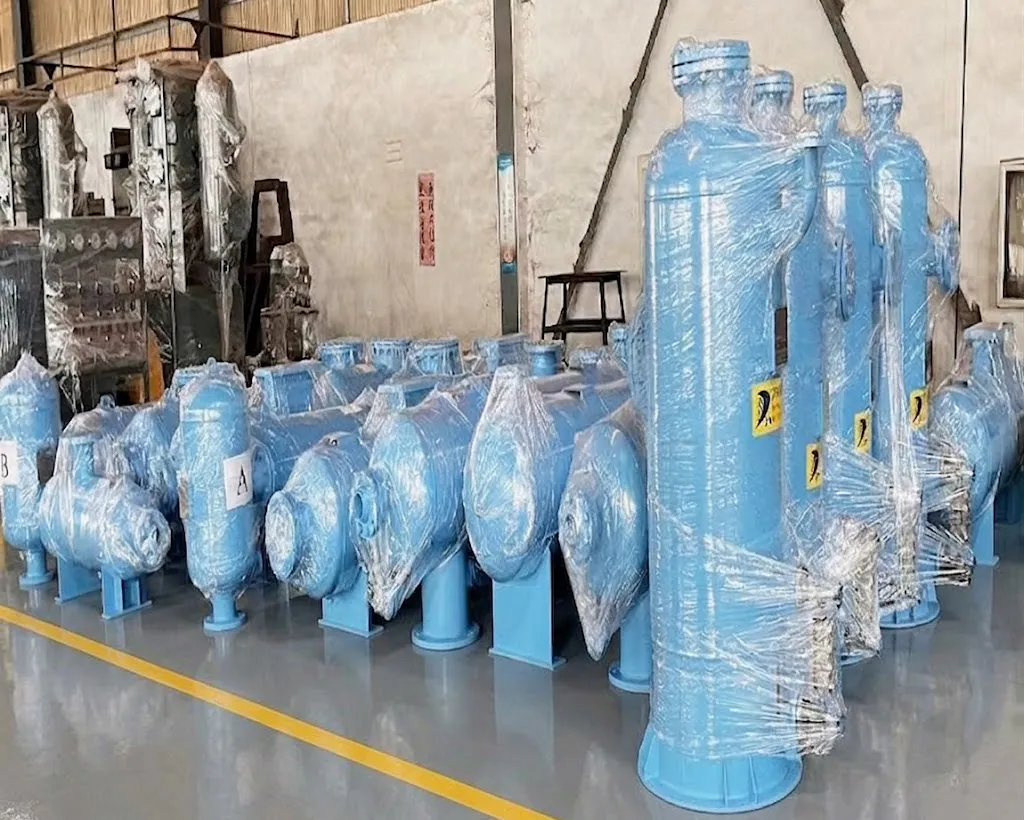
The manufacturing infrastructure that supports oil free reciprocating air compressor production is vertically integrated: our in-house foundry produces the grey and nodular cast iron cylinder blocks and crosshead guides; our precision machining plant holds the bore finish tolerances critical to oil free piston ring performance; our heat treatment facility processes crankshaft forgings and connecting rods; and our combined test centre validates performance and pressure integrity of every reciprocating air compressor before release. A provincial-level compressor research institute operating within the same facility drives ongoing material development for oil free compressor ring and seal compounds, ensuring that advances in PTFE composite technology translate into extended ring life and improved performance in our current production reciprocating air compressor range.
70+
Years of Production
320
Employees
600+
Production Equipment Sets
10
National Patents
ISO 9001
Since 2001
Workshop
8. Related Products & System Compatibility
We manufacture complementary industrial equipment that pairs directly with this oil free reciprocating air compressor, enabling customers who need both compressed air generation and end-use equipment to consolidate sourcing with a single technically qualified supplier. This approach simplifies system integration, narrows the scope of technical interfaces requiring multi-party coordination, and provides a single point of contact for long-term aftermarket support across the complete compressed air production and utilisation system built around this oil free reciprocating air compressor.
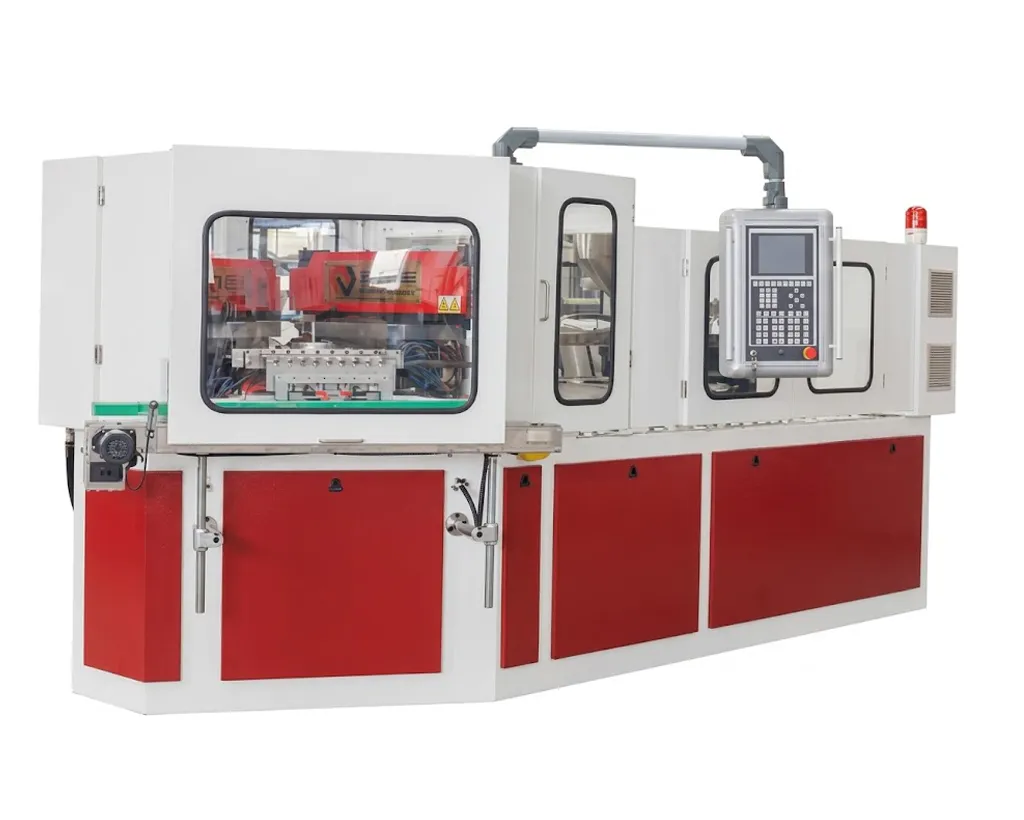
ISBM Machine — One-Step Injection Stretch Blow Moulding
For PET container producers where both oil free compressed air supply and blow moulding equipment are required, we manufacture the ISBM Machine — an injection stretch blow moulding system that integrates preform injection, stretch orientation, and final blow in a single continuous production cycle. Pairing the EP-DW-100/8 oil free reciprocating air compressor with our ISBM machines creates a vertically integrated PET production capability with guaranteed air purity at the compressor output, matched flow capacity at the blow station inlets, and a single supplier relationship for the complete compressed-air-to-container production system. This one-stop supply arrangement eliminates the interface and warranty disputes that commonly arise when compressor and blow moulding equipment are sourced separately from different manufacturers with different technical specifications for the compressed air inlet.
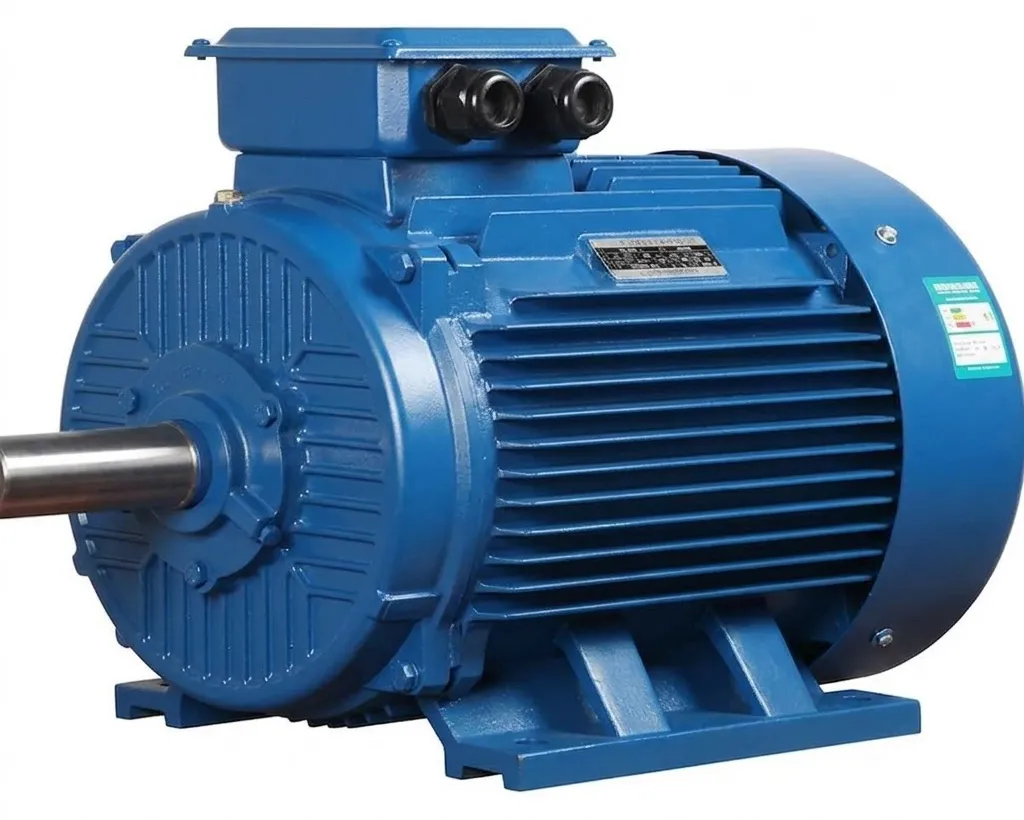
Three Phase Asynchronous Motor
The EP-DW-100/8 oil free reciprocating air compressor is driven by a three-phase asynchronous motor rated at 600 kW, available at 6 kV or 10 kV supply voltage. We supply matched high-voltage motor units from our qualified supply chain, factory-coupled to the oil free reciprocating air compressor and run-tested as a complete motor-compressor drive package prior to shipment. This integrated supply and testing approach eliminates the shaft alignment and electrical protection calibration uncertainties that arise when motors and compressors are purchased separately and assembled on site — and it provides the buyer with a single set of factory acceptance test records that documents the combined performance of the motor and the reciprocating air compressor under actual operating conditions, not calculated nominal values.
Frequently Asked Questions
Editor: PXY